Top MERV Rating for 14x28x4 Air Filters in Homes with Pets
Walk into a pet household running a one-inch fiberglass filter, and you can usually feel the air difference inside ten minutes. Dust returns to surfaces by the next morning, and anyone in the home with cat or dog allergies will start sniffling well before the second cup of coffee. A 14x28x4 four-inch pleated filter solves most of that, but only when the MERV rating actually matches what the household needs.
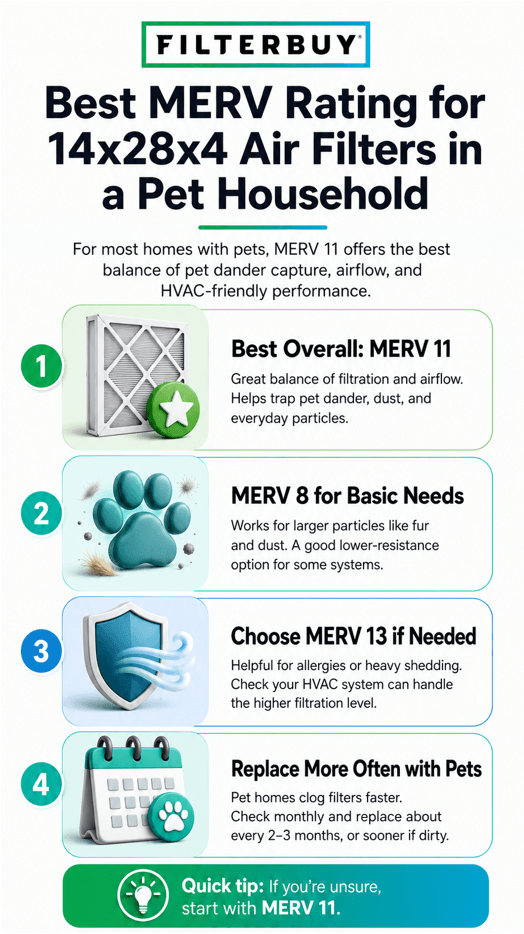
For most pet households running this size, MERV 11 is the right call. It catches pet dander and the fine particles traveling alongside it without making the HVAC system fight for airflow. Households with documented asthma or diagnosed allergies are the case for MERV 13, but only after a technician has confirmed the system can handle the extra static pressure. MERV 8 is the floor most pet households should keep walking past.
The actual cut size on a 14x28x4 reads 13.5 by 27.5 by 4. That four-inch depth is the part that matters most. More pleated media translates to more dust-holding capacity and a longer service life, which is exactly what pet households need from a filter.
TL;DR Quick Answers
14x28x4 Air Filters
A 14x28x4 air filter is a four-inch deep pleated HVAC filter. The nominal label reads 14 by 28 by 4 inches, while the actual cut size measures 13.5 by 27.5 by 4. For pet households, MERV 11 is the default we recommend for everyday dander control. Step up to MERV 13 when asthma or allergies are in the picture and the HVAC system has been verified airflow-compatible. Replace every 60 days while pets are shedding year-round.
Top Takeaways
MERV 11 is the right default for 14x28x4 air filters in most pet households.
The actual cut size measures 13.5x27.5x4, even though the nominal label reads 14x28x4.
Replace every 60 days when pets are in the home, versus every 90 days without.
MERV 13 fits asthma or allergy households running an HVAC system that has been verified airflow-compatible.
A four-inch pleated filter beats a one-inch filter at the same MERV rating because the deeper pleat holds more dust.
What 14x28x4 Actually Measures
Filter sizing trips up more homeowners than any other part of the buying decision. The number on the box is the nominal size, which describes the slot in your return rather than the filter itself. The actual cut size runs about half an inch smaller on each face, so the filter can slide in and out without binding. For a 14x28x4, the actual measurement reads 13.5 by 27.5 by 4 inches.
The first two numbers describe the face of the filter. The last number is the depth, and a 14x28x4 carries the full four inches. That extra depth holds significantly more pleated media than a one-inch slot filter, which is why these bigger filters last longer between changes and impose a smaller penalty on system airflow.
The Wikipedia overview of how an air filter works is a good place to start for anyone who wants the broader context before settling on a MERV tier.
Why MERV Matters More In Pet Households
MERV stands for Minimum Efficiency Reporting Value. The residential scale runs from 1 to 16, and the higher you go, the smaller the particles a filter is rated to catch.
Pet dander measures between 2.5 and 10 microns, which puts it squarely inside the range that a MERV 11 filter is rated to catch at high efficiency. Dust mites, mold spores, and the smaller skin flakes that drift alongside dander all live in the same particle-size band.
Here is how the three most common tiers stack up for pet homes:
MERV 8: Catches lint, pollen, and most everyday household dust. Not enough on its own, once cats or dogs live in the home.
MERV 11: Captures pet dander, fine dust, and most mold spores. This is the default we recommend for one or two pets in households without diagnosed respiratory issues.
MERV 13: Captures the smallest particles in the residential range. Bacteria-sized particulates and the very fine smoke particles common in homes near busy roads or wildfire-prone areas show up at this tier. Save it for households with asthma or allergies, and only after a technician has confirmed the blower can handle the added static pressure.
The airflow caveat trips people up more often than it should. A four-inch pleated 14x28x4 carries far more surface area than a one-inch filter, which means even at MERV 13, the airflow penalty is much gentler than most homeowners assume. Older single-stage systems are still the ones to watch carefully.
How Filter Choice Connects To Your Wider HVAC System
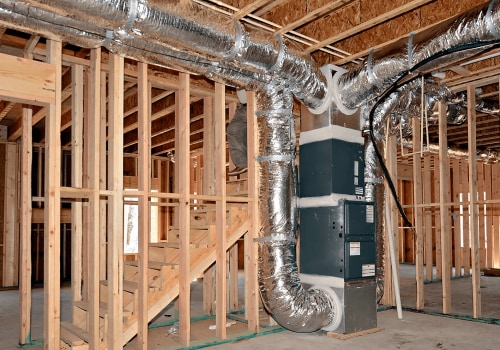
A great filter mounted in a leaky duct system is doing half a job. If conditioned air bleeds out of cracked seams in the attic before reaching the supply registers, the filter is pulling less air than the box says it should. Worse, return-side leaks suck unfiltered attic and crawlspace air directly into the system, which means more dust and dander cycling through the home and a filter that loads up well ahead of schedule.
That is why pet households are best served by treating the filter and the duct system as one decision rather than two. Coral Gables homes feel this most because year-round AC use cycles air through the same ducts thousands of times more often than a heating-dominant climate would. Anyone weighing both upgrades together can read the matching logic worked through in detail in this overview of standard HVAC filter sizes that pair with duct sealing in Coral Gables.
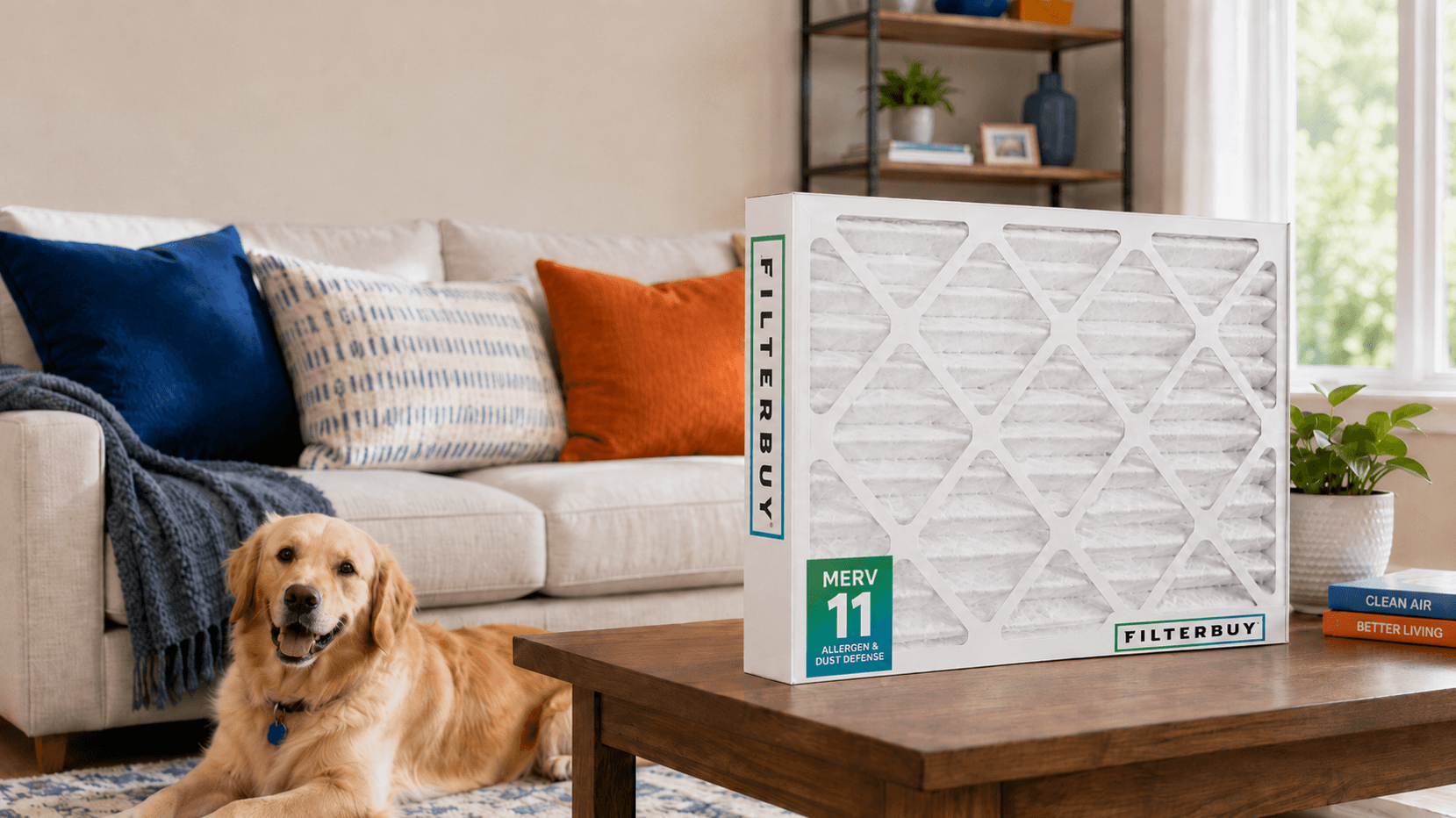
“For 14x28x4 filters in homes with pets, MERV 11 is where I send people first. It catches dander reliably without forcing the blower to fight for airflow.”
Essential Resources On 14x28x4 Air Filters
Pet owners shopping for the right MERV in this size do better with some context on how indoor air, allergens, and HVAC efficiency actually interact. The seven sources below are the ones we keep handy when customers ask where the recommendations come from.
Get The Federal Take On Home Air Cleaners
The EPA's residential guide explains where filtration fits into the broader indoor-air picture and what each MERV tier actually delivers inside a real home.
Source: EPA Air Cleaners and Air Filters in the Home
Understand Why Pet Dander Hits So Hard
The Asthma and Allergy Foundation of America's pet allergy page covers what dander actually is and how it spreads through a home, with practical detail on where filtration fits in a household allergen-reduction plan.
Source: AAFA Pet Allergy: Are You Allergic to Dogs or Cats?
Read The Lung Association's Take On Pet Dander
The American Lung Association covers how shed skin proteins from cats and dogs go airborne, how long they stay there, and which reduction strategies hold up in real homes.
Source: American Lung Association Pet Dander
Match Your Filter Decision To Asthma Risk
The CDC's controlling-asthma guide names the indoor exposures that matter most for sensitive household members, with pet allergens high on the list. It is essential reading before any household commits to a MERV 13 upgrade.
Source: CDC Controlling Asthma
Learn What Filter Choice Costs You At The Meter
The U.S. Department of Energy's AC maintenance guide walks through how filter condition affects system efficiency and total energy use over a cooling season.
Source: Energy.gov Maintaining Your Air Conditioner
Know How HVAC Pros Talk About Filtration
ASHRAE's filtration and disinfection technical resource gives you the engineering-level view of MERV testing and the air-cleaning standards that sit behind every filter label on the shelf.
Source: ASHRAE Filtration / Disinfection
Get Practical Tips For Hiring A Heating And Cooling Pro
ENERGY STAR's contractor-hiring guide walks through the questions worth asking before signing anyone on, including how a good technician should evaluate the duct system and filtration setup before recommending changes.
Source: ENERGY STAR 10 Tips for Hiring a Heating and Cooling Contractor
Supporting Statistics
Three numbers worth keeping in mind while choosing a MERV for the 14x28x4 size:
Most American Households Have A Dog Or Cat
About 42.6% of U.S. households own at least one dog, and 32.6% own at least one cat. Together, that works out to roughly 77.5 million pet-owning homes cycling dander through their HVAC systems every day. From what we see in our own customer data, multi-pet homes are the ones that benefit most from moving up from MERV 8 to MERV 11.
Source: AVMA National Pet Week 2026 Pet Ownership Data
Pet Allergens Show Up Even In Homes Without Pets
NIEHS researchers have found dog and cat allergens in nearly every U.S. home they have tested, including homes where no pet has ever lived. The protein particles ride in on clothing and settle into carpets, bedding, and upholstery. That alone makes a strong case for keeping a pleated MERV 11 or higher filter in the slot, even before a pet ever joins the household.
Source: NIEHS Pet Allergens
Cat Dander Stays Airborne For At Least Thirty Minutes
Allergist Dana Wallace, MD, has noted on the ACAAI patient resource that cat dander is the smallest of any common indoor allergen, which keeps it airborne for at least 30 minutes after any disturbance in the room. That long airborne window is exactly what a higher-MERV pleated filter is built to capture before the particles can resettle on surfaces and re-trigger symptoms.
Source: ACAAI Pet Allergies
Final Thoughts And Opinion
After manufacturing filters for over a decade and serving more than two million households, we have watched pet owners default to one of two extremes, and most of them are buying the wrong tier.
Some buy MERV 8 because the price tag is half what a four-inch pleated filter costs. The result is real dander still moving through the air and an evaporator coil that clogs faster than it should. Others jump straight to MERV 13 because higher feels safer on the box, then choke older single-stage systems that were never built for that much resistance.
For a 14x28x4 in a typical pet household, the MERV 11 four-inch pleated filter is the right answer most of the time, in most homes.
A few situational notes from the field:
Households with documented asthma or allergies should consider MERV 13. Confirm airflow with a technician first.
Anyone running a system older than 15 years should stay at MERV 11 unless a technician green-lights the move to MERV 13.
In Coral Gables and anywhere else with year-round AC, the replacement cadence drops to every 60 days. Florida humidity loads filters faster than the calendar suggests.
The cheap white fiberglass filter is a false economy in pet homes. It catches lint, lets dander pass through, and asks you to dust more often. Skip it.
Frequently Asked Questions
Q: Is MERV 13 Too Restrictive For Older HVAC Systems With 14x28x4 Filters?
A: Sometimes. The four-inch depth on a 14x28x4 filter helps a lot because more pleated surface area means lower static pressure than the same MERV in a one-inch slot. Even so, single-stage systems older than 15 years sometimes struggle with the added resistance. Have a technician check static pressure before committing to MERV 13 if your unit predates 2010.
Q: How Often Should Pet Households Change A 14x28x4 Filter?
A: Every 60 days is the right baseline for households with one or two pets. Pull the filter at 45 days for inspection if there are three or more shedding animals in the home, indoor smokers, or year-round AC use. A gray, matted filter goes straight into the trash. Pet-free homes can usually stretch to 90 days of the same size.
Q: Why Does A 14x28x4 Filter Actually Measure 13.5x27.5x4?
A: Filter slots are built slightly larger than the filter, so the unit can slide in and out without catching on the housing. The number on the label is the nominal size that matches the slot opening. The actual cut size runs half an inch smaller on each face. The same convention applies across most HVAC filter sizes, not just 14x28x4.
Q: Does Activated Carbon Help With Pet Odors In A 14x28x4 Filter?
A: Activated carbon adds adsorption capacity for volatile organic compounds and pet odors, which is why upgraded pet-household filters include it. The carbon layer does not replace MERV-rated particle filtration. The right call depends on what bothers you most: choose an activated carbon MERV 11 four-inch filter for odor priority, or a higher MERV without carbon for dander priority.
Q: Can A Single 14x28x4 MERV 11 Filter Handle Multiple Pets?
A: Yes, but the replacement cadence has to move up. A four-inch MERV 11 carries plenty of dust-holding capacity for a multi-pet household, though it will load up faster than the same filter in a single-pet home. Check it at 45 days and replace it at 60.
Q: Is A Pleated 14x28x4 Filter Better Than Fiberglass For Homes With Cats And Dogs?
A: A pleated filter wins outright in pet households. Fiberglass filters were designed to protect the HVAC system from large debris, not to clean the air your family breathes. The pleated four-inch construction in a 14x28x4 catches dander and fine dust,t along with the smaller particles of fiberglass, simply lets through.
Find Your 14x28x4 Filter For The Home You Actually Live In
Cleaner air for everyone in the household, pets, and people alike, starts with the right filter in the slot you already have. Shop 14x28x4 pleated filters built in the USA for pet households at filterbuy.com and set a replacement reminder that keeps the dander out and the air moving.
Learn more about HVAC Care from one of our HVAC solutions branches…
Filterbuy HVAC Solutions - West Palm Beach FL
1655 Palm Beach Lakes Blvd., Ste 1005 West Palm Beach, FL 33401
(561) 448-3760
https://maps.app.goo.gl/VarpgNZnxuPQuW8A7